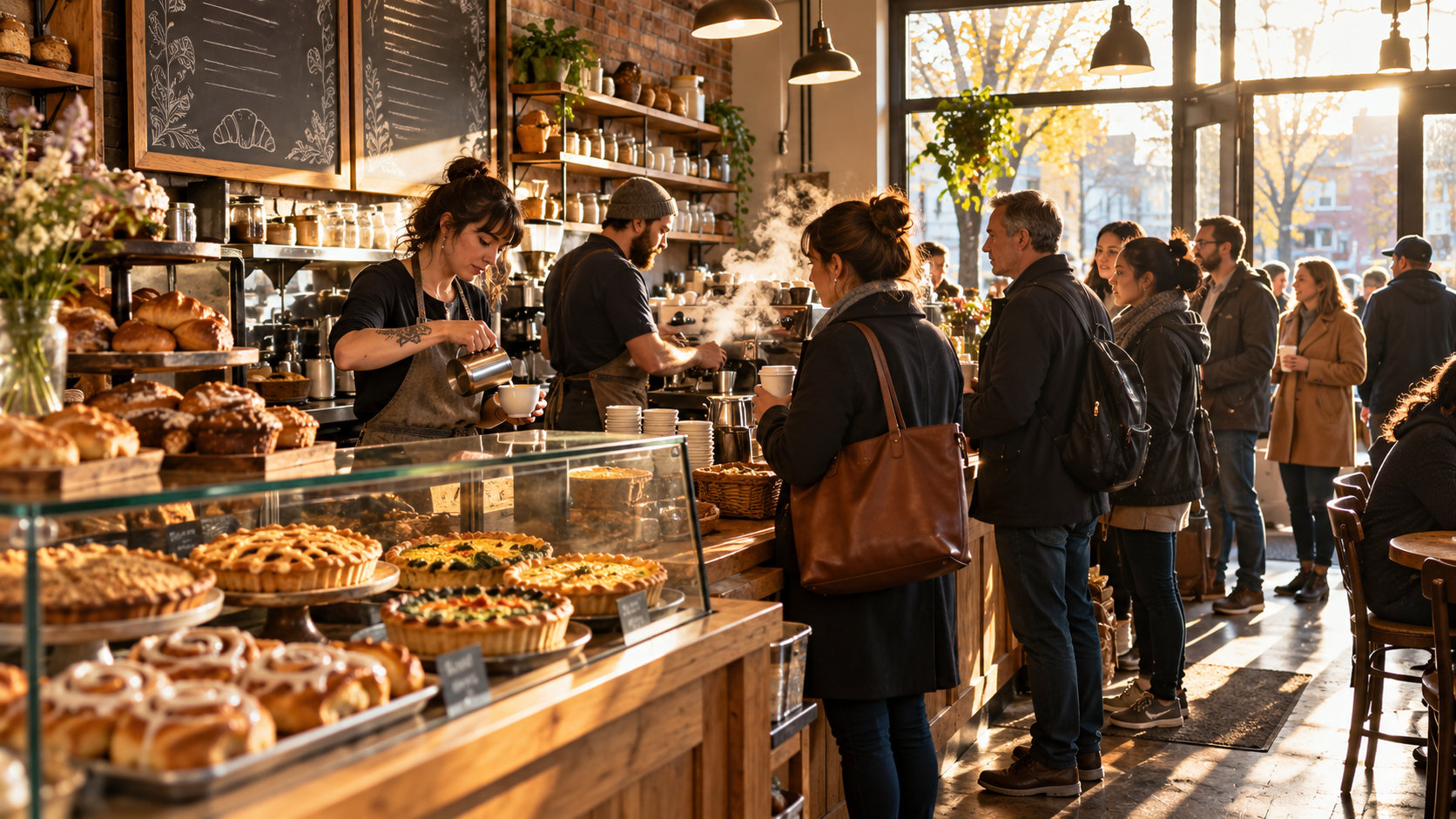
Earlier this year, we almost bought a coffee shop
Earlier this year, my wife and I came close to buying a commercial bakery with a coffee shop right at its entrance. The bakery could turn out 700 pies in 10 hours.
The deal fell apart in financing. But going through the numbers taught me something most marketers never see.
Most marketers only see a coffee shop from the outside: the logo, the Instagram, the website. Buying one means looking at it from the inside. You see the morning rush, the margins, and where the money actually comes from.
Here's what I learned. Every lesson applies to any independent business going up against a chain, whether that's a café down the street from a Starbucks or a plumber competing with a private-equity rollup.
1. The morning rush is won on systems, not coffee
The breakfast crowd isn't browsing. They're on their way to work, and they pick whoever gets them in and out fastest.
That takes an efficient, predictable drive-thru with a team that knows its job, or curbside handoffs that are ready when the customer pulls up. Both is better.
A customer who waits too long once doesn't complain. They just go to the chain next time.
2. Every drink has to taste the same, no matter who makes it
The coffee has to be fresh, hot and taste the same every time. Specialty drinks follow the same rule: macchiatos, lattes, seasonal specials, signature drinks. The latte your regular gets at 6 a.m. from your best barista has to match the one the new hire makes on Saturday.
This is where the chains win, and I've seen it from the inside. From 2014 to mid-2018 I managed a digital rollout across 900 Dunkin' Donuts locations. Working with NCR and TechLink Services, we installed roughly $7 million in equipment.
Every store had to come out the same. We built three teams of installers who replicated our methods, and we supplied templates for the digital sign layout. Four digital menu boards, lined up side by side, met the brand's specs every time: a 12-degree downward tilt, no gaps between screens, no cords showing. We walked through 24 tests with NCR on every single installation.
That's how 900 stores serve the same cup. Nothing is left to whoever happens to be working that day.
David Jenyns makes the same point in Systemology: write down how your business does its work, so anyone can do any job and get it right. The goal isn't to become a chain. It's to make sure your quality doesn't depend on who showed up today.
That's the part most independents miss. You can have a chain's consistency without its sameness.
3. Then beat them where a franchise can't follow
Once you match a chain on consistency, you get to compete on everything a franchise can't change. A chain's menu is set at headquarters. Yours is set by you.
Our plan was to build the menu around something the chains don't do well: keto-friendly, high-protein food for mature adults who want to hold on to their muscle as they age. Grab-and-go breakfasts, high-protein snacks, savory quiches and grab-and-go dinners, plus signature drinks and seasonal specials from our own recipes. A franchise can't add any of that without corporate approval.
The franchise recipe is the chain's strength. It's also its ceiling. Every customer who wants something different is a chance to win them over to your way of doing things.
4. Don't let customers stop at the front counter
We knew from the first day that the flow of the whole place had to change. The coffee counter sat too close to the front door, so people grabbed a coffee and left without ever seeing the rest of the bakery.
Our plan was to move the register and coffee checkout. To get there, every guest would walk past a demonstration bakery built around a massive 16-foot-wide, 7-tray rotating oven. We wanted them back where the smell of cinnamon, yeast and warm quiches is made.
Your website works the same way. If visitors can get the one thing they came for on the first screen and leave, they never discover everything else you do.
5. A bakery built for 700 pies a day sits idle most of the year
The bakery could make 700 pies in 10 hours. That capacity earns its keep on four or five big holidays a year, when everyone wants pie at once.
The rest of the year, those ovens were the real opportunity. Our plan was to keep them busy with products people buy every week: savory quiches, high-protein snacks and grab-and-go dinners for the coffee shop's case.
Spare capacity also opens up planned orders that walk-in traffic never will:
- School fundraisers: pie sales that pre-sell hundreds at once
- Realtors: closing gifts for their buyers
- Restaurants that don't make their own desserts
- Corporate gift baskets for clients and staff
- Holiday preorders for Thanksgiving and Christmas
Each of those is a buyer searching for something specific. A realtor looks up closing gifts. A restaurant owner looks up wholesale desserts. A school parent looks up pie fundraisers. If your website doesn't have a page that answers that search, the order goes to whoever does.
Here's what was at stake. At a low average price of $14.95 and a 45% margin, 700 pies is about $4,700 in profit per production day. Twelve full production days a month, counting the big holiday rushes, would be worth roughly $678,000 a year in profit on about $1.5 million in sales. To be clear, that's speculation. It's what the ovens could have earned, not what they did, and building to that level could easily have taken 18 to 24 months.
That's also why the deal fell apart. Capacity isn't demand. If those ovens had been running at 700 pies a day year-round, we could have shown the lender proven demand and a path to growth. A lender finances what you can prove, not what your equipment could do.
What this means for your business
Take the coffee out and the lessons hold for any independent business:
- Win the rush with systems people can count on.
- Write down how you do things, so quality doesn't depend on who's working.
- Compete where the chain can't follow: your menu, your story, your service.
- Lead customers past everything you offer, in your store and on your website.
- Fill spare capacity with planned, repeat buyers, and make sure your website answers what they search for.
That last one is what Local Growth Digital does. We build websites and search visibility for independent businesses competing against chains, from contractors to espresso carts, cafés and bakeries.
Want to see what your customers find when they search for what you sell? Call me at 570-761-6765 or send a message.
— Bill Watchulonis